Showing posts with label old posts. Show all posts

Tuesday, April 7, 2015

We Will Be Consumed When Love Explodes! A Thank You to Lena Hall


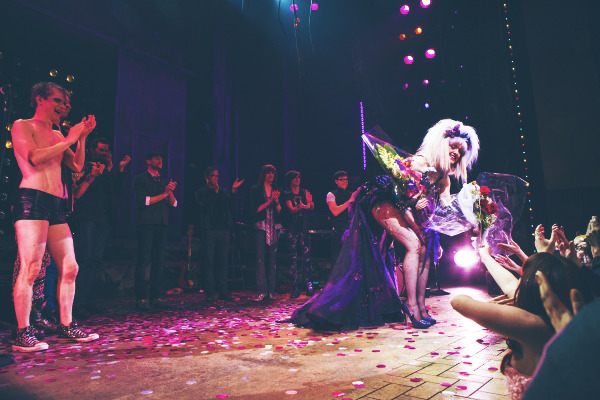
Image courtesy of Theaterboys

Saturday night at the Belasco Theater, sometime around 11 PM, Lena Hall tugged the earpiece from her ear and let it hang discarded around her neck.  This minuscule moment, a pause before the next verse of her solo number The Long Grift, is burned into my memory.  Reflected on her face with her ear free of reverb was the fact that Lena Hall and Yitzhak were both all-in, with nothing left to hold back.  In a freeze frame of time, it embodied the performance in its entirety, from start to finish.  In that one distinct action, Lena Hall was raw and ready to release everything she had left inside of herself.  
Ms. Hall, who has been playing Yitzhak for the last year in Hedwig and the Angry Inch, is a force to be reckoned with.  The role of Yitzhak, the husband, back-up singer, and roadie for Genderqueer Punk Rock star Hedwig Robinson, is one with minimal dialogue, but the role carries a whopping half of the show's emotional weight.  It is a role that requires a dedication to physical labor and dramatic background acting as well as the vocal chops to hit the powerhouse notes of Whitney Houston while still maintaining the heavy gravel akin to the stylings of Tom Waits.  The show belongs to Hedwig, the title character, and to John Cameron Mitchell, the original Hedwig and current actor in the role.  Hedwig is the star, but for this one night the stage did not belong to Hedwig. The night belonged entirely to Yitzhak.

I can’t recall ever having been in a room more filled with love than that theater.  The seats and standing room were filled with people who wanted to wish Lena Hall the very best, to see her final performance and to be with her in this experience.  The show was more than just a show; it was a party in her name.  Love poured out from the audience with every standing ovation after standing ovation, character and fourth wall were broken on occasion and built right back up with love as adoration with the building blocks of improvisation.  The caustic relationship between Hedwig and Yitzhak, one built on a volatile combination of jealousy, love, and violent self-doubt soared above and beyond the usual (and always moving) battle between two bare and frustrated forces.  For all the love that the audience gave unto Lena Hall, John Cameron Mitchell and Hedwig multiplied it by thousands.  There was an intimacy to the performance, with the looks given to one another, to touches and lingering hands and softer than usual quips of tongue.  Watching as well as being in the theater surrounded by trembling fans was to be in Hedwig’s oven, with love reverberating around us like the sound of Lou Reed on American Forces Radio against the walls.  Watching Lena Hall’s face as she acted her way through, fighting off tears and tearing her throat out with powerful vocals was an experience in empathetic transcendence.  This was a show, above all, not just about watching the details but also about feeling them in our bones.  

Hedwig and the Angry Inch is an experience to be had more than once.  As of Lena Hall’s last show, I have seen the show three times.  That would be less than some, and more than others.   I wasn’t lucky enough to catch the train before John Cameron Mitchell put the wig back on his head, and I never saw how Lena played off of the other actors.  I came to this show fresh, wet behind the ears in relation to this particular piece of musical theater history and not knowing exactly what to expect, aside from what the general populace had told me.  The moment in time was, for me, one of personal upheaval, and I needed something to carry me through.  There had been too much death in my life recently, too much striving half-heartedly for out of focus goals.  I was tired, grasping at straws.  Most importantly I think, I needed a distraction.  John Cameron Mitchell as Hedwig is himself a transcendent, but there was something different about Yitzhak.  I was more than moved, I was shaken.  I recognized myself in Yitzhak, and I attribute that entirely to Lena Hall’s performance.  Lena Hall and Yitzhak helped me come to terms with my own gender fluidity in a way that I had not yet done before, through her mannerisms and her dedication to presenting both masculine and feminine elements of the character.  What’s more, I empathized deeply with Yitzhak’s plight of playing second fiddle, with the frustration and adoration both simultaneously exuded by Lena’s performance.  I understood Yitzhak’s loving anger and sadness intimately, with his desire to be loving at odds with his need for self-actualization.  Lena Hall’s performance as Yitzhak touched something inside of me and, most importantly, shook me awake.  I was inspired again, to write, to draw, to create, and to reflect on the creation of others.  Hedwig and the Angry Inch was what I needed in that moment, and Yitzhak stood firmly relatable like an island in a storm.  

For this wave of passion and inspiration, I want to thank Ms. Lena Hall for her art.  

I don’t believe any of this would have been possible without her sheer talent for embodying another human being.  So often in musical theater, an actor has to be chosen who is perhaps a better singer than an actor, or the reverse, for a more dramatic role.  Lena Hall was able to not only play the part, but to become it with a raw passion and untempered vocal fury.  Off stage and on; she engulfed herself in the role, playing the part as if she were wearing a second skin, even when she didn’t have to.  Her performance as Yitzhak read like an act of love in itself.  I spent hours watching YouTube videos and tracking her Yitzogram hashtag because I needed something with which to relate.  She tackled the role of Yitzhak, with its minimal dialogue and maximum emotional impact, with a dedication often reserved for Oscar contenders or singers destined to join the 27 club.  I cannot speak to having been moved by Hedwig and the Angry Inch at a young age like so many others, but I can speak to it now, in my adulthood, and to being moved by Lena Hall.  

Thank you, Lena Hall, for the inspiration, and for the unrelenting passion of your work.  Thank you for shining like the brightest star.  Your dedication to your craft and your winning personality have guaranteed another long-term fan.  Thank you, for everything.

And all the strange rock and rollers
You know you're doing all right
So hold on to each other
You gotta hold on tonight

And you're shining
Like the brightest stars
A transmission
              On the midnight radio

Sunday, June 2, 2013

I'm not crazy - in an institution: Punk at the Met and an air of unease


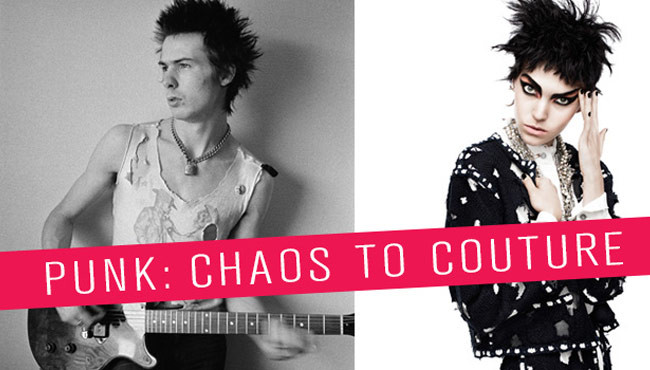
I entered into the Punk: Chaos to Couture exhibit at the met with mild reservations but general excitement. The Met has a spectacular track record for good fashion exhibits, and this tribute to 1970's Anti-Establishment counter culture is well positioned in contrast to Impressionism, Fashion, and Moderism exhibit.  The two fashion-centric exhibits sit next door to one another, representing two very distinct, different styles from different times with one strong common bond: the desire to reject the previous generation and innovate.  The general excitement I had for the Met's Punk exhibit outweighed my reservations, given the museum's history with fashion exhibits, yet the reservation remained.  I was unsure how an exhibit about a culturally subversive and anti-establishment fashion culture could possibly function well within, well, the establishment itself.  

As I walked through the exhibit I stewed in my thoughts and feelings on the subject.  I was uncomfortable, and I couldn't put my finger on why.  The clothes were gorgeous, and the couture garments displayed exemplified the influence that Punk culture had on high fashion.  From the unbeatable king of alternative beauty Alexander McQueen to the founding queen of punk fashion herself Vivienne Westwood, most of the works showed a true understanding and love for the Punk concept, the deconstructive and reconstructive nature of it all.  (I say most purposefully; not all of the high-end designers represented truly understood the style they were attempting to imitate.)  It wasn't until I came to the end of the exhibit, face to face with the gift shop that accompanies every exhibit that it really hit me.  

What is so uncomfortable about this whole concept isn't that punk couture is being displayed as art (which it is), or that the punk subculture was being exhibited as art-historically relevant (as it should be).  What made me uncomfortable was that this whole grand curated plan goes against everything Punk Rock stood for in a way seemed to sanitize and commercialize it.  Now, commercializing Punk Rock isn't a new thing, and neither is sanitizing it, but it seemed crisper in this environment, clearer in its wrongness than it ever had to be before.  

The exhibit begins with a display of clothing that is not, as the rest of the exhibit will be, high-fashion couture.  The earliest examples presented are more representative of street clothes.  Torn, punched, blended clothing and torn tee-shirts rest on on mannequins with synthetic Halloween wigs atop their plastic heads.  It begins with a display of what the inside of Vivienne Westwood's original shop looked like, with torn tee-shirts in abundance.  The display of Vivienne Westwood's shop was ingenious as a way to engage to viewer in understanding the grunge and gritty origins of punk fashion, through the first designer to decide this was something she wanted to do and became a name for it.  The shop as historical context distracts, though, for the issue of torn see-shirts and studded leather jackets in tatters on mannequins.  This casual street clothes fashion style was meant to be a rejection of the norm, to be a cheap way of self-expression through pure unadulterated anarchy.  It was a movement for the youth with no money and no patience for the establishment.  To see the fruits of this frustrated labor exemplified as something on display in the Metropolitan Museum of Art alongside Versace and Dolce & Gabanna was unsettling.  To see the Met selling pristine tee-shirts with images and slogans on them in reference to the punk movement seemed, in that moment, almost criminal.  

I imagine that a genuine punk ripe from 1970s disillusionment would find themselves disgusted by the whole idea of this exhibit, and that in itself made me uncomfortable.  It felt to me not as an example of couture work inspired by a subculture and only couture work inspired by said subculture, but an appropriation of a subculture into the sterile environment of high art.  It wanted to represent a historical fashion movement but only managed to present the movement as an untouchable high-art concept. 

This is, by no means, a call to boycott the exhibit.  Most of the exhibit is wonderful, and the couture works inspired by the movement are high fashion art at it's finest.  I would simply advice to approach it with a bit of skepticism, and to not purchase a shirt from their store.  That is, unless you intend on re-appropriating  the wild commercialism of it it in your own way, in true Punk style. Then have at it, fuck shit up.

Wednesday, January 23, 2013

I am Tough, but I'm No Cookie: Praising Lana Winters


Author's Note: I set to write about the superb character that is Lana Winters in American Horror Story before the season was over.  What is so spectacular about American Horror Story is that each season is self-contained, without the risk of spinning wildly out of control.  I could have waited, yet I didn't   Now that the season is over, I’ve gone back and added to this, but my opinion has not changed.
Here are a few praises hailing Lana Winters, played by Sarah Paulson.
 gif by snowwhitebemberg on Tumblr
I am a far cry from Ryan Murphy’s biggest fan.  I gave up on Glee after a long struggle with his sloppy writing and contradictory characterization, and I have barely held on to The New Normal for the sake of a cast that I’m fond of, in spite of it's frankly masturbatory nature.  That said, I have held on tightly to American Horror Story.  It seems that, in spite of Ryan Murphy, this show has succeeded in being quality television.  Some would argue that it’s not, based on a few key flaws, but I’m not here to defend American Horror Story so much as praise one of the new seasons main characters, Lana Winters.
I would go as far as to say that Lana Winters is one of the best characters on TV today.
This is in part thanks to Sarah Paulson’s incredible acting, relaying the story of a strong woman going through hell and remaining, throughout it, sane.  Appropriately traumatized to the point that she cannot physically allow the baby she will loathe to be aborted, because she can’t open her legs far enough, can’t keep from being loud, and can’t stop imagining all the death she’s seen.  Traumatized, but sane.  With Sarah Paulson’s skill, we really feel the truth behind her emotions.  This makes her relatable in ways that the writing of her story would not be able to do on it’s own, with a less sufficient actress at the helm.
What is truly spectacular about Lana Winters, beyond the pure chops of Sarah Paulson, is that she is not a stereotype.
Last season, we were presented with a cast of characters all cut out of a very unified mold: the residents of a rich Los Angeles neighborhood. While they were (mostly) all different, individually interesting characters, they all had elements of that tricky little writing tool that Ryan Murphy tends to fall into: namely, character typing. We have the bigoted older southern belle, the psychopathic romantic interest, the misunderstood teenager and the sexually diverse gay couple who don’t avoid stereotypes so much as slide comfortably into them.  His characters are often a sloppy cut-and-paste job from TVTropes.  We can safely say that season 1, with it's aimless focus and squeaky wheels, was a test run for ideas and artistic license.  We see many of these tropes again in season 2 ( see the Nazi Doctor Arden for your bigoted older gentleman, or Axe Murderer Grace for your psychopathic love interest—one that subsequently gets turned on its head quite interestingly), but one character really seems to pull away from the mold: that of our Heroine, Lana Winters.
When we were first presented with a strong, gay, female reporter, I was wary for a few reasons.  My first concern was for her longevity.  American Horror Story has proven that the writers have no qualms against being cruel for the sake of a deeply disturbing and theme-appropriate story.  While this is a daring and wonderful quality for a television show, given how driven today’s media is to please the fans, it sets the viewer up not to have hope.  It seemed inevitable that she would be sullied in some way, or sacrificed to the gears of plot for the sake of Kit and Sister Jude, the show’s headliners.  A second concern I had, and a much more major one at that, was how Ryan Murphy would handle her.  Despite being a gay man himself, his track record for writing gay characters who don’t rely on their sexuality as a defining characteristics is rather poor.  Kurt Hummel, originally a uniquely individual character, has become a series of statements on gay rights without much concern for any other aspect of his life.  He is gay, and that is why he exists.  Oddly enough, that was the first critique of Kurt given to me long ago that made me begin to see the light and release my tight grip on the show.  The same can be said about the Zachary Quinto’s character in the first season of American Horror Story, whose plot is entirely based on his relationship, and of course is also the case with the entire working premise of The New Normal.  More often than not, Ryan Murphy’s gay characters are defined by their homosexuality.  
On top of all of this Lana is also a woman, and I don’t trust Ryan Murphy’s shows to pass the Bechdel test on a regular basis.  There are numerous articles about how poorly Ryan Murphy writes female characters, so I won’t go into that so much here.  What I will talk about is lesbians.  While the negative treatment of gay women by gay men is a massive stereotype in its own, Ryan Murphy feeds into stereotypes very often.  His own character, Bryan Collins of The New Normal, is essentially a a representation of Ryan Murphy himself, and a very campy, occasionally over the top one at that.  Bryan can really be used as a reflection of how Ryan Murphy sees himself, and it doesn't bode well for his opinion of lesbians;  Bryan's opinion of lesbians feeds directly into the stereotype.  This leads me to believe that Lana, being a lesbian, would not be treated or depicted fairly, but rather through the stereotypical lens of a gay man. 
So I worried about Lana.  I worried that she would die, or that she would be relegated to a love interest, or a butch stereotype, or rely solely on her sexuality as a plot device. I am happy to say that I couldn't be more wrong.
Lana Winters has shown herself to be multidimensional.  She is strong and independent, occasionally cold and callous, but not without a heart or soul.  She has moments of weakness, moments where she is terribly wrong, and moments when she is right on target.  She was even, in the penultimate episode, shown to be terribly flawed, emphasized by her own state of repentance in the finale (which isn't solely repentance, keeping her from being a glorified saint—there is personal gain in that as well).  She isn't the perfect strong hero that she could have been.  When it came to beginning her career anew, she chose the safety of not outing herself in her book and not risking being sent back to Briarcliff by digging once again into the state of the place.  She chose an escape through applause, her goal from the very beginning (Now That’s What I Call Continuity).  It shows the depth of a character that she can do something that so many fans have been enraged by, and not actually be wrong by doing it.  It is a purely human reaction, one that she falls into before she takes Kit’s words as fuel to the flame and becomes who she wanted to be once again.
I know that a great deal of this post was about how much I dislike Ryan Murphy, but that’s important.  Ryan Murphy’s flaws as a writer emphasize how Lana shines through his usual pitfalls into being a product of true inspiration.  Lana has proved to be her own character, and with every trope thrown her way she has slipped by with a giant fuck you.
gif by elmumin on Tumblr